
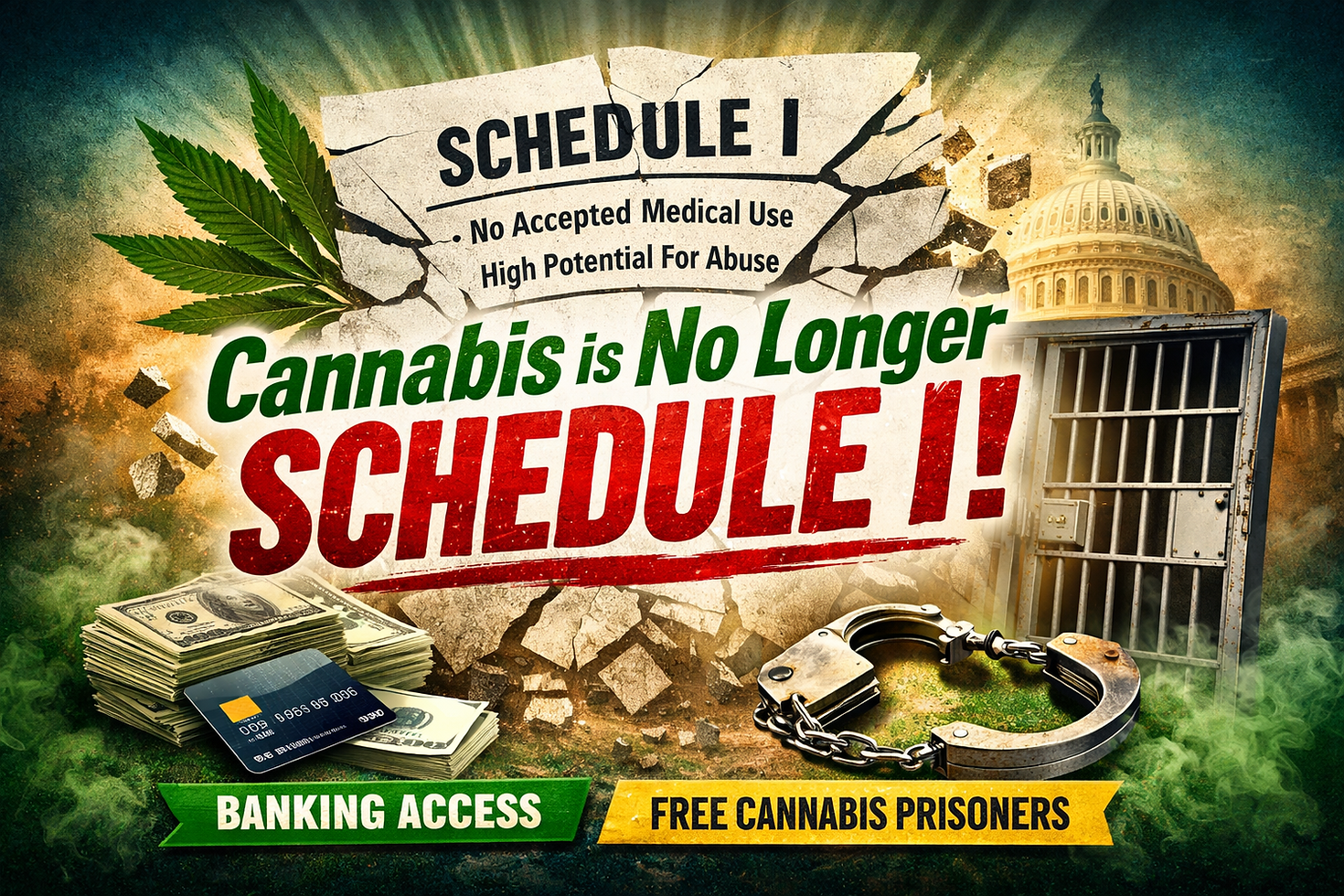
Cannabis is No Longer Schedule I — A Historic Shift That Changes Everything
The federal government has officially begun the process of removing marijuana from Schedule I, the most restrictive drug classification under U.S. law. For the first time in modern history, cannabis is no longer being treated the same as heroin or cocaine — a powerful acknowledgment that decades of federal policy were out of step with science, medicine, and reality.
This shift represents a historic turning point for patients, businesses, and communities across the country. While it does not equal full federal legalization, removing cannabis from Schedule I fundamentally changes how the federal government views the plant — and that change has far-reaching consequences.
Why Getting Off Schedule I Actually Matters
Schedule I status has been the root cause of nearly every major challenge facing the cannabis industry. Under that classification, cannabis was defined as having “no accepted medical use” and a high potential for abuse — a claim that has been widely disproven by decades of medical use, state-level legalization, and scientific research.
Because of Schedule I, cannabis businesses were:
Locked out of traditional banking
Subjected to excessive federal taxes
Forced into cash-heavy operations
Restricted from meaningful research
Criminalized at the federal level
Removing cannabis from Schedule I is not just symbolic. It dismantles the legal foundation that justified these barriers in the first place and opens the door to more rational regulation.
Banking Access Could Finally Begin to Open
One of the most immediate and impactful effects of cannabis no longer being Schedule I is the potential expansion of banking access.
For years, most banks refused to work with cannabis businesses due to federal risk, even when those businesses were fully licensed and compliant under state law. This forced legal operators to rely heavily on cash, creating safety risks, accounting challenges, and unnecessary inefficiencies.
With cannabis no longer classified among the most dangerous substances:
Financial institutions may feel more comfortable offering accounts
Payroll, vendor payments, and tax compliance become easier
Cash handling risks are reduced
Lending and credit become more realistic
While additional legislation is still needed for full protection, removing Schedule I status eliminates a major psychological and regulatory barrier that kept banks on the sidelines.
---
Justice Demands the Release of Cannabis Prisoners
This policy shift also raises an unavoidable moral question.
If cannabis is no longer considered one of the most dangerous drugs under federal law, no one should remain incarcerated for non-violent cannabis offenses.
For decades, people have lost years — and sometimes entire lives — to arrests, convictions, and prison sentences over cannabis. These laws disproportionately harmed low-income and minority communities while creating lifelong barriers to employment, housing, and opportunity.
True reform must include:
Release of individuals imprisoned for non-violent cannabis crimes
Expungement of past cannabis convictions
Restoration of civil rights and economic opportunity
Rescheduling without justice is incomplete reform. You cannot acknowledge that a policy was wrong while continuing to punish people under it.
---
What This Means for the Future of Cannabis
Removing cannabis from Schedule I signals a broader shift toward normalization. It strengthens the case for smarter regulation, safer commerce, expanded research, and eventual federal reform.
For legal businesses like Dispensary Near Me, it represents progress toward operating like any other legitimate industry — with access to banking, stability, and long-term growth. For patients and consumers, it brings credibility and consistency. For communities, it offers a chance to repair harm caused by decades of failed policy.
---
Conclusion
Cannabis leaving Schedule I is not the end of reform — but it is a historic beginning.
It marks the federal government’s first real acknowledgment that cannabis does not belong in the most dangerous category of drugs. From banking access to criminal justice reform, this shift lays the foundation for a fairer, safer, and more honest cannabis industry.
The path forward is clear. The policies must now catch up to reality — and to justice.


Ik vond dit artikel goed gestructureerd en informatief. De impact van digitale platforms op moderne communicatie wordt hier duidelijk beschreven. Aanvullende achtergrondinformatie over dit onderwerp is te vinden op de website. Deze inzichten helpen om digitale trends beter te begrijpen.